
7 min read
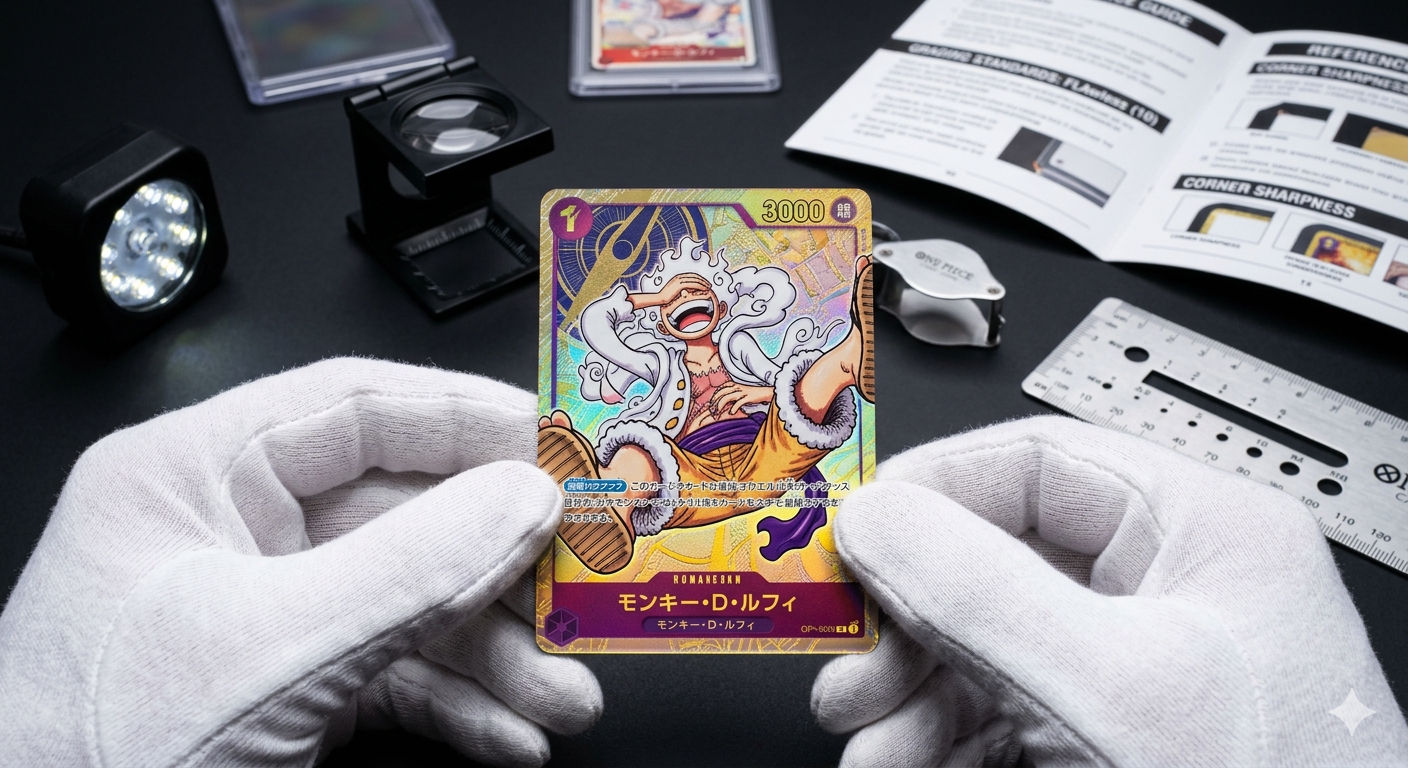
How to Spot a PSA 10 Candidate Before You Submit
The most expensive mistake in card grading is not a damaged card. It's a grading fee paid on a card that was never going to grade 10. PSA's Economy tier costs around $25 per card. If you submit 10 cards and 4 come back PSA 8 or below, you've paid $100 for grades that almost certainly didn't recover their cost.
Pre-screening is the skill that separates profitable graders from expensive ones.
What PSA Actually Looks For
PSA grades on four criteria, weighted roughly equally:
Centering: The borders must be within 60/40 front, 75/25 back. Cards with obviously uneven borders will not grade 10, no matter how good the rest of the card looks.
Corners: All four corners must be sharp and free of whitening, fraying, or rounding. One bad corner means PSA 9 at best.
Edges: The card's four edges must be clean. Rough cuts, chipping, or colour loss on the edge will drop the grade.
Surface: The face and back must be free of scratches, print lines, print defects, surface haze, and staining.
The Pre-Screening Setup
You need three things:
1. A jeweler's loupe: 10× magnification is the standard. A quality loupe with LED light lets you see corner whitening, surface scratches, and edge chips that are completely invisible to the naked eye. This is the single most valuable tool in your workflow.
2. A UV flashlight: A UV light source reveals surface scratches, print defects, and restoration work that standard lighting misses entirely. Shine it across the card surface at a low angle.
3. Good directional lighting: A bright desk lamp angled at roughly 45° to the card surface. Tilt the card slowly in the light and watch for any areas that catch the light differently. These are usually scratches or surface haze.
Corner Check
Hold the card and look at each corner in turn under the loupe. You are looking for:
- Whitening: white fibres showing through where the corner has been touched or bent
- Fraying: the corner tip separating into layers
- Rounding: a blunt or rounded corner instead of a sharp point
One Piece cards have a tendency toward corner wear because the card stock is relatively soft. Be strict: if a corner looks borderline under the loupe, it will fail PSA's graders.
Edge Check
Run the card edge-on under the loupe, rotating it slowly. Look for:
- Rough or uneven cuts (manufacturing issue, but still affects grade)
- Colour chipping along the edge
- Any nicks or dents
Surface Check
This is where most One Piece cards fail. The foil and special finishes on SEC and SR cards are prone to micro-scratches from pack pulling, sleeving, and storage.
With your UV light or angled desk lamp, tilt the card in multiple directions. Scratches will show as bright lines catching the light differently from the surrounding surface.
Surface haze (a cloudy or dull area on the card face) is common on cards stored in poor conditions or handled frequently. It will cost you a PSA 10.
Centering Check
This one you can evaluate with the naked eye. Hold the card at arm's length and compare the width of the borders on opposing sides. Left vs right, top vs bottom.
If the difference is obviously visible, if one border is noticeably wider than the other, you're likely outside the 60/40 threshold for a PSA 10. Some collectors use a ruler or a centering tool for borderline cases.
The Honest Assessment
After pre-screening, sort your cards into three piles:
- Submit: clean corners, clean edges, no surface issues, good centering
- Maybe: one borderline element (slight centering, one corner that might be okay)
- Don't submit: clear issues that will cap the grade at PSA 8 or below
For "maybe" cards: calculate the ROI at PSA 9, not PSA 10. If the PSA 9 value still justifies the fee, it might be worth submitting. If not, sell it raw.
One Piece-Specific Issues to Watch
Foil scratching: SEC and parallel cards have foil finishes that show scratches far more easily than standard cards. These often come from factory packing, not your handling, but they still affect the grade.
Print lines: Visible lines running across the card from the printing process. Common in certain One Piece print runs. A severe print line can drop a card to PSA 8 regardless of condition.
Centering variance: One Piece cards have higher centering variance than Pokemon or Magic cards. Always check centering first, before spending time on anything else.
The Bottom Line
Pre-screening takes 5 minutes per card. That 5 minutes can save you $25 and the disappointment of a bad result. Use a loupe, use a UV light, be honest with yourself, and only send cards you genuinely believe are PSA 10 candidates.