
12 min read
PSA Grading: The Complete Beginner's Guide for One Piece TCG
Card grading has gone from a niche hobby to a mainstream part of the One Piece TCG collecting scene. PSA 10 slabs of SEC cards change hands for thousands of euros. But most collectors who start grading make the same expensive mistakes: submitting cards that won't grade well, packing them incorrectly, or misunderstanding how the economics work.
This guide covers everything from scratch.
What Is PSA Grading?
PSA (Professional Sports Authenticator) is the world's largest third-party grading service. You send them raw cards, they authenticate them and grade their condition on a scale from 1 to 10, then seal them in a tamper-evident plastic case (called a slab) with a certification label.
A PSA 10 is a Gem Mint card, essentially perfect. A PSA 9 is Mint with minor imperfections. Below PSA 8, the economics rarely make sense for One Piece cards.
Why Grade at All?
Three reasons:
1. Value uplift. A PSA 10 SEC card is worth significantly more than the same card raw. The premium varies by card but commonly ranges from 2× to 5× the raw price.
2. Authenticity guarantee. A slabbed card comes with PSA's certification that it's genuine. This matters as One Piece cards become increasingly valuable and fakes more sophisticated.
3. Liquidity. Graded cards sell faster and more reliably, especially to international buyers who can't inspect the card in person.
What to Grade: The Golden Rule
Only submit cards where the PSA 10 value minus the raw cost minus grading fees is meaningfully positive.
The math needs to work before you pay grading fees.
Cards worth grading:
- SEC (Secret Rare) cards from any set
- Alt-art SR cards featuring popular characters (Luffy, Zoro, Shanks, Roger)
- Leader SEC variants
- Cards you pulled in clearly near-perfect condition
Cards not worth grading:
- Common and uncommon parallels
- Cards with any visible centering issues, surface haze, or edge wear
- SR cards from oversaturated sets where the PSA 10 premium is thin
The Grading Scale Explained
| Grade | Description | |-------|-------------| | PSA 10 | Gem Mint. Four perfect corners, no surface issues, perfect centering (60/40 or better). | | PSA 9 | Mint. One minor imperfection allowed: slight off-centering or a very minor corner touch. | | PSA 8 | Near Mint–Mint. Noticeable imperfection on one surface, or slight wear on two or more corners. | | PSA 7 and below | Rarely profitable for One Piece cards. |
Pre-Screening Your Cards
Before spending money on a submission, inspect every card thoroughly.
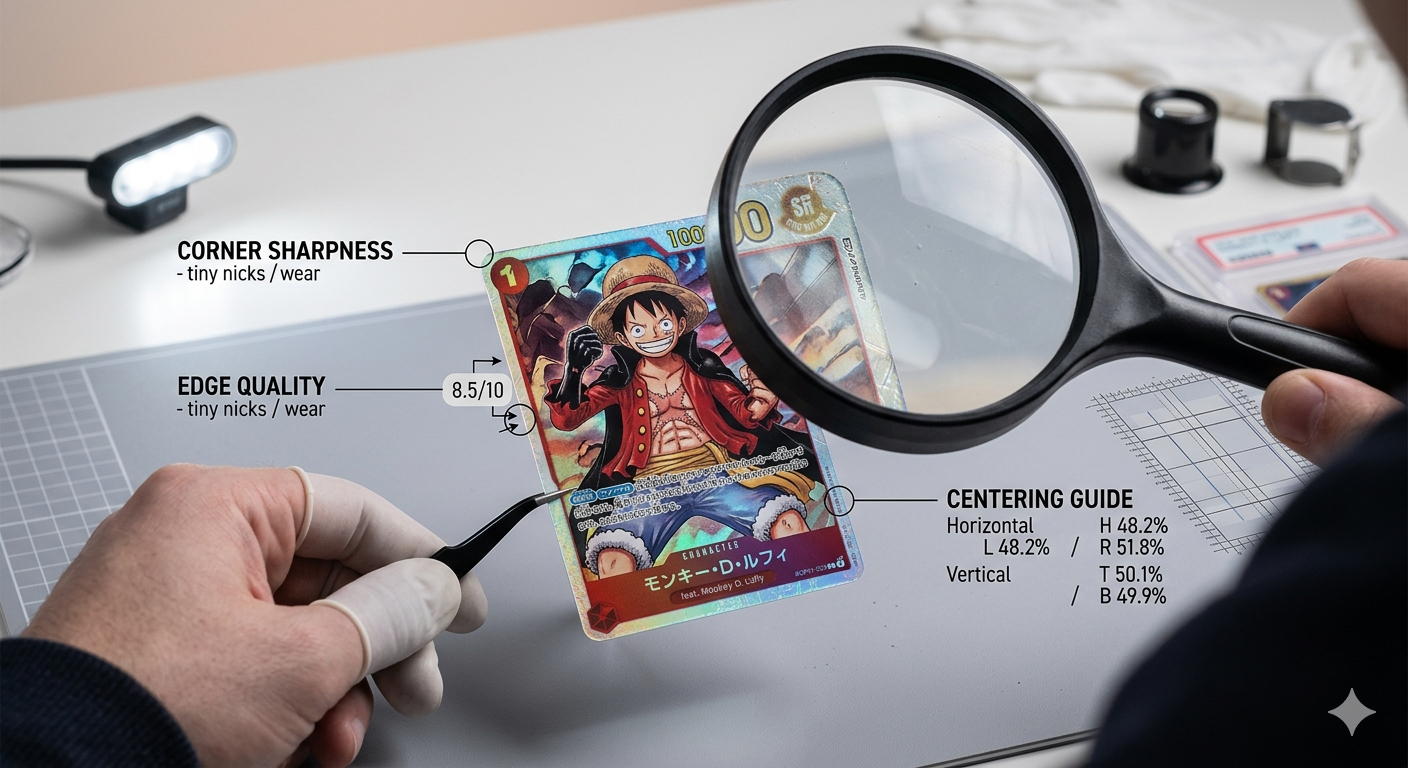
You need two tools: a jeweler's loupe (10× magnification) and good directional lighting. Under magnification, check:
- Corners: any whitening, creasing, or fraying disqualifies a PSA 10
- Edges: roughness or chipping means at best a PSA 9
- Surface: scratches, print lines, and haze are common on One Piece cards
- Centering: hold the card at arm's length and look at border consistency on all four sides
Also use a UV flashlight to reveal surface defects invisible under normal light.
If anything concerns you, don't submit. A PSA 8 costs the same to grade as a PSA 10.
The Supplies You Need
Before the card reaches PSA, it has to travel there safely. The right supplies are non-negotiable:
- Perfect Fit inner sleeves: sleeve the card first. These ultra-thin sleeves protect the surface from the holder.
- Card Savers: PSA's preferred holder. Semi-rigid, easier to slide cards in and out without damage.
- Bubble mailers: the outer shipping layer. Never ship grading submissions in a padded envelope alone.
- White cotton gloves: handle high-value cards without leaving fingerprints or oils.
Choosing a PSA Submission Tier
PSA offers several service tiers differentiated by price and turnaround time:
- Economy (~$25/card): Slowest. Currently 60–90 days. Best for most submissions.
- Regular (~$50/card): Faster turnaround, better for time-sensitive submissions.
- Express and above: For cards where speed or declared value matters.
For most One Piece collectors, Economy is the right default. The savings vs faster tiers add up quickly when submitting multiple cards.
How to Submit
- Create an account at psacard.com
- Start a new submission order, select your service tier
- List each card individually with its declared value
- Pack and ship (see our full packing guide)
- Drop off at your chosen carrier
PSA accepts submissions from outside the US. Shipping internationally is straightforward, but factor in the return shipping cost.
Reading Your Results
When your grades come back, PSA emails you a report. Each card gets:
- A grade (1–10)
- A cert number (unique identifier, searchable on PSA's registry)
- Population data (how many copies have graded at that level)
Low pop counts for a PSA 10 are generally positive: fewer graded copies exist, which supports a higher market price.
Is It Worth It?
For the right cards, absolutely. The PSA 10 premium on One Piece SEC cards is real and structural. But grading is not a guaranteed profit. It requires discipline in card selection, honest pre-screening, and sound ROI math.
Run the numbers. Screen your cards carefully. Start small with 3–5 cards on your first submission to learn the process before scaling up.