
6 min read
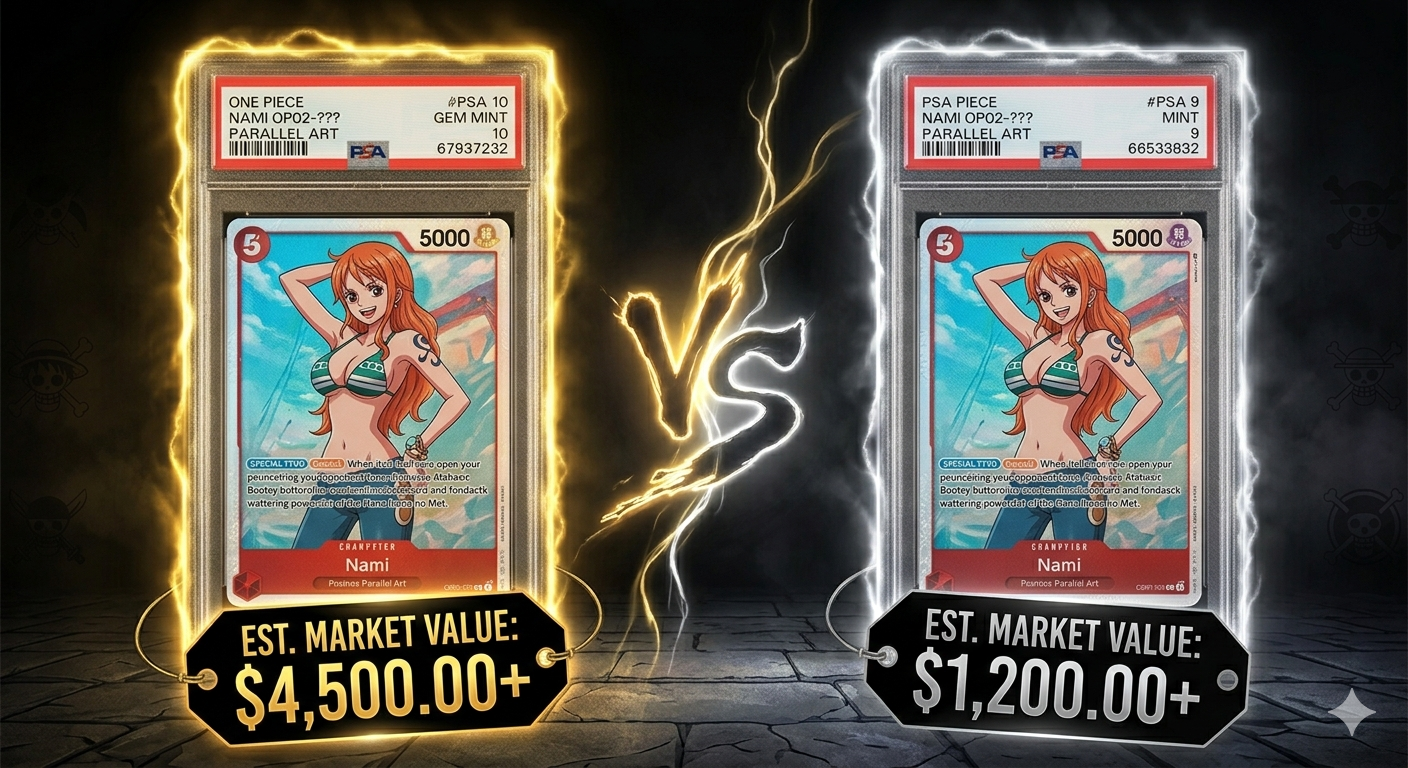
PSA 10 vs PSA 9: Is the Grade Difference Worth the Risk?
When you send a card to PSA, you're gambling on a grade. Most collectors aim for a 10, but realistically, even a beautifully preserved card might come back a 9. The question is: does a PSA 9 still make the economics work?
The answer is more nuanced than most guides admit.
The Value Gap Is Real
For One Piece TCG's most desirable cards, the PSA 10 premium over PSA 9 is dramatic. Using Nami Manga OP01-016 as an example:
- Raw NM: ~€250
- PSA 9: ~€400
- PSA 10: ~€530+
The gap between PSA 9 and PSA 10 is smaller than the gap between raw and PSA 9. That's the story across most SEC cards in the game. Collectors have a strong bias toward perfect copies, yet One Piece cards being very recent, the difference between PSA 9 and 10 is not that big However, as time goes by, the gap could grow.
Why the Gap Exists
Collector psychology drives most of it. A PSA 10 slab feels categorically different to a PSA 9. It's a perfect object. PSA 9s are desirable but they come with an asterisk.
Population dynamics amplify this. High-population PSA 9s are common for popular cards. PSA 10s remain relatively scarce because One Piece card stock is genuinely difficult to grade perfectly. Scarcity at the top grade maintains the premium.
Resale confidence: PSA 10s sell faster and with less negotiation. Buyers of high-value slabs are often willing to pay a significant premium to avoid the uncertainty of a 9.
When PSA 9 Still Makes Sense
Not every grading decision is about maximising the premium. PSA 9 is the right outcome in several scenarios:
Budget cards with thin margins: if you're grading a card where the 10 value is €80 and the 9 is €55, the €25 difference over a €25 grading fee still represents a positive return on a card you acquired cheaply.
High-volume collectors: if you're submitting 20+ cards per batch, a realistic 70% PSA 10 rate means 6 PSA 9s per batch. Those 9s still contribute to overall profitability.
Cards where 9 demand is strong: some sets and characters have collectors who specifically target PSA 9s as an affordable entry point to a slabbed copy. These cards have healthier 9-to-10 ratios.
When PSA 9 Kills the ROI
High-value SEC cards: for cards where the 10 is €300 and the 9 is €100, a PSA 9 might not even recover the grading fee over the raw price. The entire thesis of the submission was the 10 premium.
Cards you bought specifically to grade: if you paid raw market price to acquire a card and submit it, a PSA 9 return means you've paid grading fees for a modest uplift that may not cover costs.
Cards with low PSA 9 demand: some cards have thin secondary markets for any non-10 grade. A PSA 9 can sit unsold for months.
How to Factor This Into Your Decision
Before submitting, run the numbers twice:
- Calculate ROI assuming PSA 10: is it compelling?
- Calculate ROI assuming PSA 9: does it still break even?
If the PSA 9 scenario still shows a meaningful positive return, the submission has a robust risk profile. You're profitable at 9 and very profitable at 10.
If the PSA 9 scenario shows a loss, you're making a binary bet on a 10. That's not necessarily wrong, but go in with your eyes open.
Realistic Grade Distributions
PSA doesn't publish grading success rates by set, but community data suggests One Piece TCG SECs grade as follows when submitted in apparently near-mint condition:
- PSA 10: ~35–45%
- PSA 9: ~35–40%
- PSA 8 and below: ~15–25%
These are rough estimates and vary significantly by set and print run quality. OP-09 had notably higher print line rates than OP-01, affecting 10 rates on that set.
The Bottom Line
PSA 9 is not a failure. It's a graded, authenticated card in excellent condition. For many submissions, a 9 still returns positive ROI. But for the high-value SEC cards where the entire grading thesis depends on a 10 premium, a 9 can mean losing money after fees.
Know the numbers before you submit. Pre-screen aggressively. And never bet more on a 10 premium than you can afford to make back at a 9.